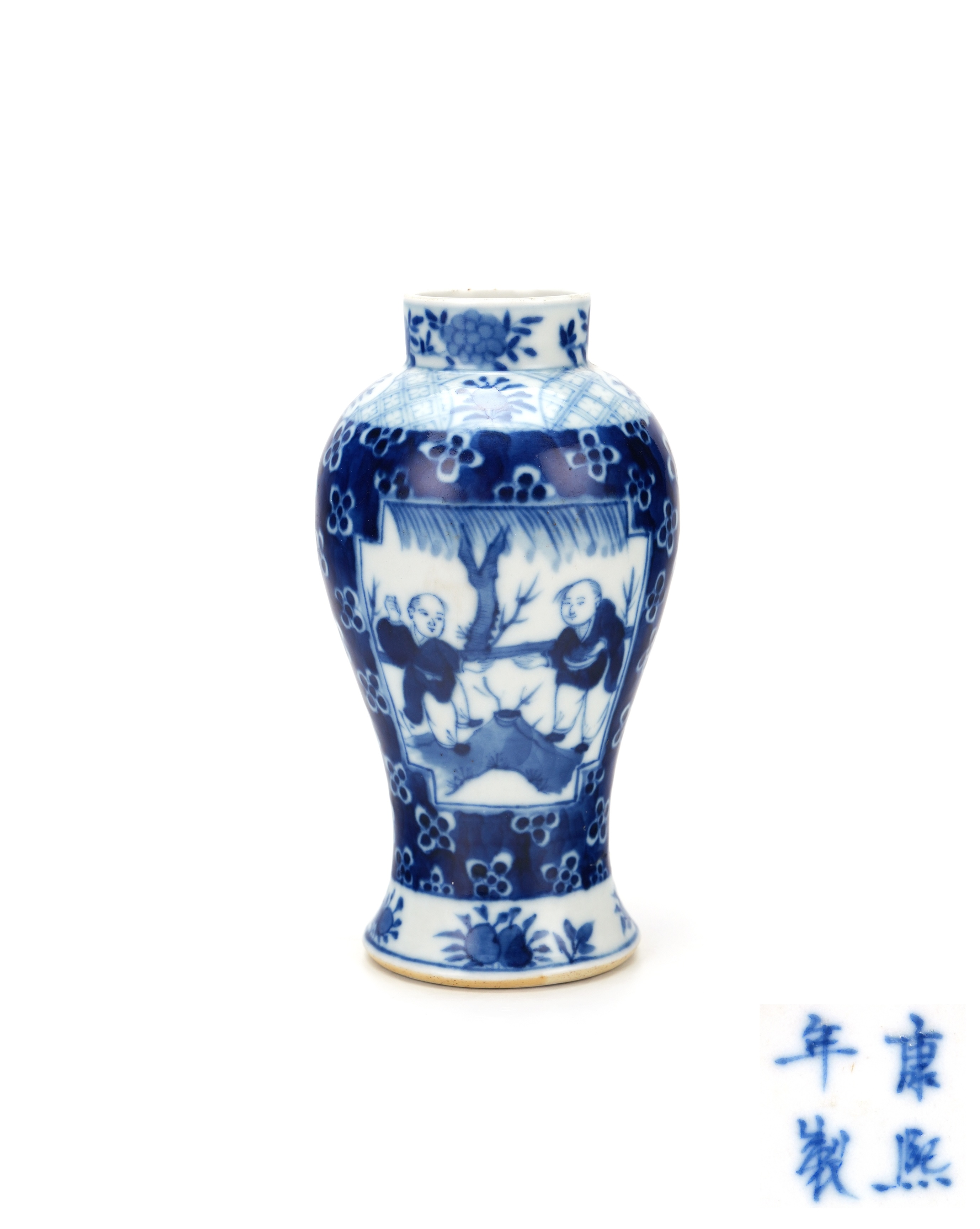
Qing Dynasty Blue and White 'Kuilong' Garlic-Head Vase


Category:
Qing Dynasty Blue and White 'Kuilong' Garlic-Head Vase
The garlic-head vase is named after its mouth, which resembles a garlic head. It originated in the Song Dynasty and was popular during the Ming and Qing dynasties. This vase has an elegant shape, with a garlic-head shaped mouth, a slender neck, a natural transition between the head and neck, graceful curves between the neck and belly, and a slightly flared high ring foot. The decoration on this vase is clearly layered, with a rich composition. The blue glaze has a beautiful, deep indigo color, and the brushstrokes are fine and meticulous. The mouth of the vase is adorned with Ruyi cloud patterns, double blue-and-white rings, the neck is painted with two geometric patterns (upper and lower), and the junction of the neck and belly is decorated with scrolling cloud patterns and Ruyi cloud patterns.
Catalogue No.: 329
Height 30cm, mouth diameter 4.5cm
Starting Bid: RMB 6,000
Estimate: RMB 30,000~40,000

The garlic-head vase is named for its garlic-bulb-like mouth. It was first fired during the Song Dynasty and became popular in the Ming and Qing dynasties. This vase has an elegant shape, with a garlic-bulb-shaped mouth, a slender neck, a natural transition between the head and neck, graceful curves between the neck and belly, and a slightly flared high-ring foot. The decoration on this vase has clear layers, a full composition, a beautiful deep blue color in the underglaze blue, and fine, neat brushstrokes. The mouth of the vase is adorned with Ruyi cloud patterns and double blue-and-white rings; the neck is painted with two bands of geometric patterns (upper and lower); and the junction between the neck and belly is decorated with scrolling cloud patterns and Ruyi cloud patterns. The belly of the vase is painted with Kui dragon patterns. The Kui dragon pattern is a deformed dragon motif, popular on bronze and jade artifacts from the Shang and Western Zhou dynasties. White pottery from the Shang Dynasty, which mimicked the shapes and decorations of bronze ware, also featured imprinted Kui dragon patterns. On porcelain, the Kui dragon pattern was primarily popular on Jingdezhen porcelain from the Ming and Qing dynasties. Below the Kui dragon pattern are Ruyi cloud patterns, and below that, plantain leaf patterns. The foot is decorated with geometric patterns. The entire vase has a beautiful deep blue color, and the brushstrokes are fine and neat. It is truly a masterpiece.
Keywords:
荣艺庭芳中国近现代艺术品专场
Upcoming auctions

Waiting for auction
Ningbo Nanyuan Hotel, Fourth Floor, Century Hall (No. 2 Lingqiao Road, Haishu District, Ningbo City)
December 17, 2023, 1:00 PM to 5:00 PM
Waiting for auction
Waiting for auction
Waiting for auction
Inquire
Follow De Rong Auction
Leave your email address to get the latest news from Derong Auction!
© 2023 Zhejiang Derong Auction Co., Ltd. All rights reserved
Contact number:0574-83897862
WeChat ID:Derongpaimai2